Food Additives Explained - Numbers, Types and Safety
Food Additives Explained: All the numbers and what to avoid
Estimated reading time: 14 minutes
Food additive numbers seem to be on every package we pick up. A quick glance down the ingredient list can leave you wondering what you are actually eating. Even on products you consider healthy, you may find numbers that mean absolutely nothing to you!
Key Takeaways
- Food additives numbers help identify ingredients, but not all are harmful; some are familiar substances like vitamin C.
- Understanding the meaning behind food additive numbers, including E-numbers, is crucial for making informed choices.
- Consumers should be aware of specific additives to limit or avoid, such as nitrites, MSG, and titanium dioxide, due to health concerns.
- Safety of food additives varies according to individual sensitivity and exposure frequency; not all additives cause harm.
- The article provides a guide to reading food labels, including a printable cheat sheet for easier shopping.
Table of contents
- Food Additives Explained: All the numbers and what to avoid
- What do all those numbers mean?
- Explaining Food Additive Codes
- What Are Food Additive Numbers and E-Numbers?
- What Do Letters After Food Additive Numbers Mean?
- Are Food Additive Numbers the Same Around the World?
- Are Food Additives Safe?
- Food Additive List: Which Numbers Should You Know?
- Which Food Additive Numbers Should You Avoid or Limit?
- Are Natural Food Additives Better Than Artificial Ones?
- How to Read Food Additives on Ingredient Labels
- Frequently Asked Questions About Food Additives
- Related Content Links
- Making Informed Choices About Food Additives
What do all those numbers mean?
Preservative (250), emulsifier (471), flavour enhancer (621). They don’t tell you anything useful about what you’re eating or why they were included in the food.
And then there you may have noticed numbers that start with E! Instead of seeing 250, it may have an E250 on some packaging. Are they different? Are they more or less dangerous?
The reality is that not all food additives are harmful. Some are familiar substances such as vitamin C, while others deserve closer attention because of potential health risks, individual sensitivities or emerging scientific evidence.
What makes things particularly confusing is that our food comes from all over the world. The additives used in imported foods may be identified differently depending on where the product was manufactured, and countries don’t always agree on which additives should be permitted.
Explaining Food Additive Codes
As a nutritionist, I believe understanding what’s in our food is far more useful than being frightened by an unfamiliar number.
In this guide, we’ll look at what food additives actually do, how to recognise their numbers, which ones are generally considered safe and which may be worth limiting or avoiding.
You’ll also find a practical food additive reference table and a free printable cheat sheet to make reading food labels a little easier. You can download this as a file on your phone and take it shopping or print it for the fridge.
What Are Food Additive Numbers and E-Numbers?
Food additive numbers are a shorthand way of identifying an ingredient without having to print long chemical names on every food label.
The international system is known as the International Numbering System for Food Additives (INS), maintained through Codex Alimentarius, an international food standards programme established by the FAO and WHO (World Health Organisation).
Many countries use these numbers, but their food labelling laws are not identical.
For example, monosodium glutamate might appear as:
- Australia and New Zealand: Flavour enhancer (621)
- European Union: E621
- United States: Monosodium glutamate
Have you wondered why some numbers have the E prefix? The E is identifying the additive as being part of the European numbering system. This happens when we have imported a product from a European company. It doesn’t mean the ingredient is dangerous or more artificial than our own equivalent. European countries simply add an e in front of our agreed number.
What Do Letters After Food Additive Numbers Mean?
Just as you start to get a handle on the numbering system and the rouge e, you may start noticing letters added to the end of an additive's number. These may be numbers such as E150a, E150d or E160a.
The letters at the end give more information about that particular additive. They distinguish additives within a related group.
For example, E150a is plain caramel colouring from Europe, while E150d is sulphite ammonia caramel colouring. The colouring is brown, but they’re manufactured using different processes.
The numbers and letters are identifiers, not safety grades.
Are Food Additive Numbers the Same Around the World?
Many food additive numbers are internationally harmonised, but the systems are not completely interchangeable.
Australia and New Zealand use numbers closely aligned with the international INS system. Europe uses E-numbers, while the United States generally identifies additives by their ingredient names.
More importantly, an additive being permitted in one country doesn’t mean it is approved for the same uses in another.
Food safety authorities may evaluate different studies, reach different conclusions or impose different restrictions.
This matters when shopping internationally or comparing imported products. Understanding an additive’s name and number helps you identify what it is, but you also need to consider the regulations applying to the food where it is sold.
Are Food Additives Safe?
Most approved food additives have undergone safety assessments, but there isn’t a single answer that applies to every additive for every person.
Safety can depend on several factors,
- including the substance
- the amount used in the product,
- frequency of exposure
- individual sensitivity such as allergies
- individual health, weight, blood pressure or maturation at the time of ingestion
- the amount of research completed to date
- Not all studies are equal and unbiased. Has the research been conducted independently and of good quality?
It’s also important to distinguish between three very different situations:
Established risks:
Strong evidence links a particular exposure or food category to an adverse health outcome.
Emerging or unresolved concerns:
Research raises questions, but scientists haven’t necessarily established harm in humans at typical dietary exposures.
Individual sensitivities:
Some people may have a different tolerance. Some additives may be tolerated by most people but cause reactions in susceptible individuals.
A useful food additive guide needs to distinguish between these situations rather than placing everything unfamiliar on a list of dangerous ingredients.
Food Additive List: Which Numbers Should You Know?
The following table highlights commonly encountered additives and additives that patients are usually most concerned about.
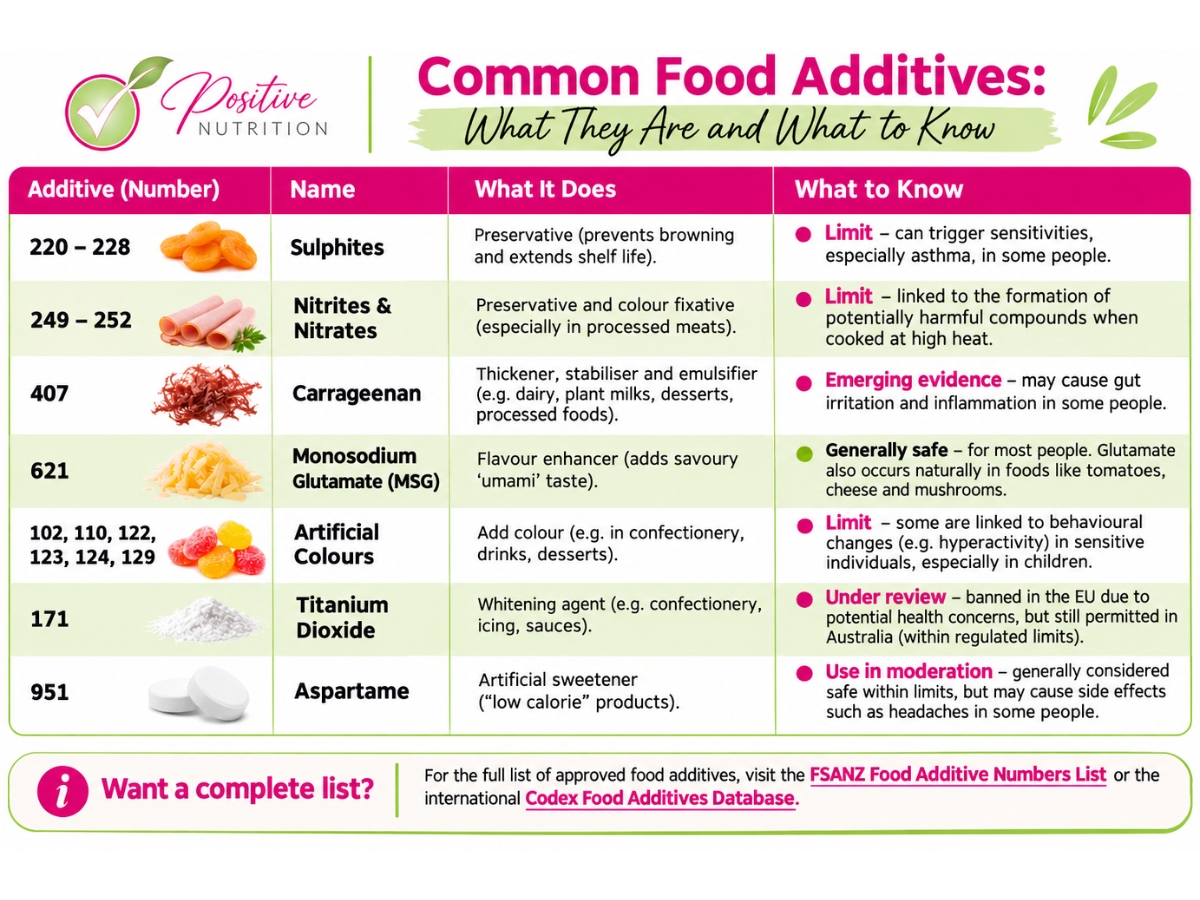
These descriptions are not a ranking of additives from safest to most dangerous. The relevant scientific evidence is discussed below.
Which Food Additive Numbers Should You Avoid or Limit?
Nitrites and Nitrates (249–252)
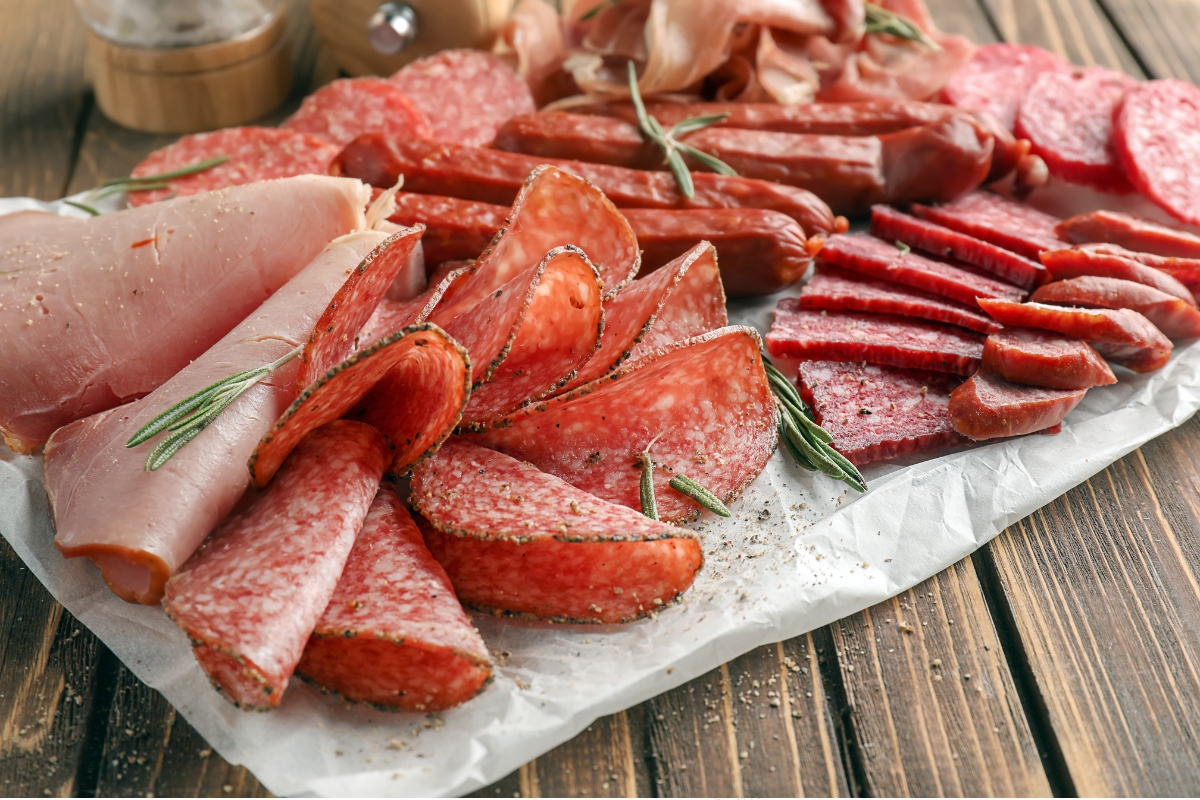
Nitrites and nitrates are commonly used in cured meats, including ham, bacon and some sausages.
They help preserve these foods and contribute to their characteristic colour and flavour.
The World Health Organization’s International Agency for Research on Cancer (IARC) classifies processed meat as carcinogenic to humans, based on sufficient evidence that its consumption causes colorectal cancer.
IARC reviewed the research and estimated that eating 50 g of processed meat daily increases the relative risk of colorectal cancer by approximately 18%.
We know that processed meat consumption increases colorectal cancer risk. So why is the use of nitrates not banned? The answer is that, at this stage, researchers haven't established exactly how much of that risk comes from nitrites and nitrates rather than other aspects of meat processing.
So why do manufacturers continue to use nitrites (249–250) and nitrates (251–252)?
These additives help prevent dangerous bacterial growth and preserve the meat's colour and flavour. Food regulators permit their use under specified conditions, despite the broader evidence linking processed meat consumption to colorectal cancer.
This is because current research hasn't established exactly how much of that risk comes from nitrites and nitrates rather than other aspects of meat processing.
But here's what concerns me.
Who is going to fund the expensive, time-consuming research needed to establish precisely how much these individual additives contribute to the risk? And if nobody funds that research, will we ever have a definitive answer?
An absence of conclusive evidence about an individual additive doesn't necessarily mean an absence of risk. It may simply mean we haven't answered all the questions.
In the meantime, consumers continue to encounter these additives in everyday foods, even though we already have strong evidence that regular processed meat consumption increases colorectal cancer risk.
Practical advice: Limit processed meat consumption, including products that claim to be nitrate-free. Removing one additive doesn't necessarily eliminate the risks associated with the food itself.
Source: WHO/IARC [4].
Sulphites (220–228)
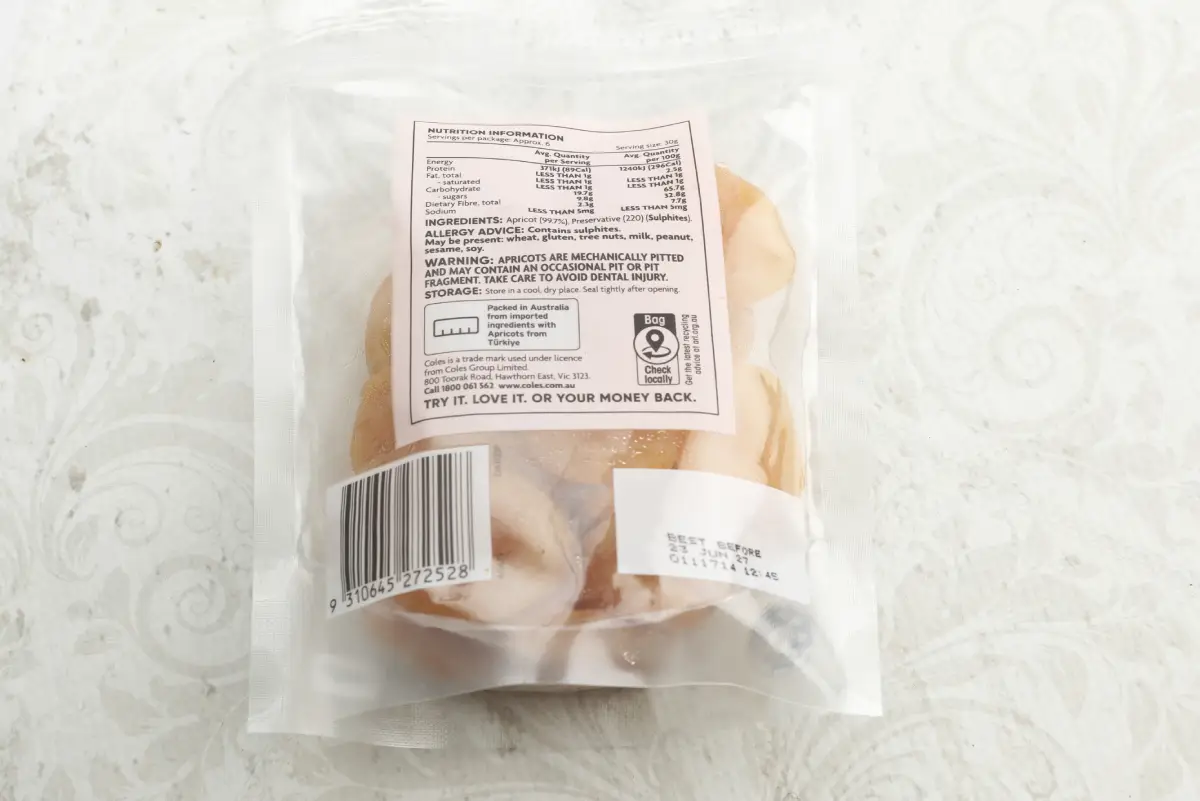
Food manufacturers use sulphites to preserve certain dried fruits, beverages and processed foods. These preservatives help prevent spoilage and unwanted colour changes.
Most people tolerate them, but they can cause adverse reactions in susceptible individuals, particularly some people with asthma.
If you have a diagnosed sulphite sensitivity, recognising these numbers is particularly important.
MSG (621)
Everyones favourite additive they love to hate. Monosodium glutamate is a flavour enhancer that enhances umami, the savoury taste we associate with foods such as mushrooms, tomatoes and aged cheese.
It has attracted considerable negative publicity, but the evidence doesn’t support treating MSG as a generally dangerous food additive.
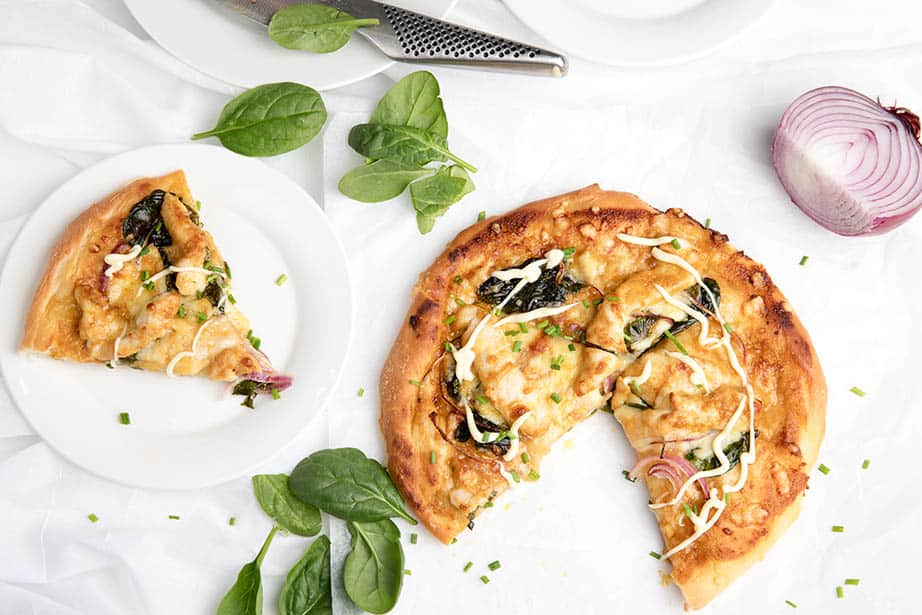
🍕 Fun Fact!
Did you know that pizza naturally contains plenty of glutamate, even when you make it from scratch?
Tomatoes and cheese both contain naturally occurring glutamate, which gives pizza its delicious savoury, umami flavour. Combining these ingredients creates a glutamate-rich meal without adding a single grain of MSG (621)!
Interestingly, our bodies process naturally occurring glutamate and the glutamate from added MSG in the same way.
FSANZ"s safety reviews haave concluded that MSG does not represent a health concern for the average person.
Some individuals report symptoms following consumption, but this is not equivalent to evidence of widespread harm.
Practical advice: There is no established reason for the general population to avoid MSG simply because it has the number 621. If you find you are someone who reacts to MSG, avoid foods containing it.
Titanium Dioxide (171/E171)
This is a favourite of mine, Titanium dioxide. It is used to give a pure white colour to food. It is often used in desserts and chocolate dishes to achieve a true white rather than an off-white.
In 2021, the European Food Safety Authority concluded that it could no longer be considered safe as a food additive because potential genotoxic effects could not be ruled out.
Genotoxicity means the potential to damage genetic material, including DNA.
This does not establish that consuming titanium dioxide causes cancer in humans. It means EFSA could not resolve an important safety concern sufficiently to establish an acceptable daily intake.
Other international authorities have reached different conclusions.
Practical advice: Consumers who prefer to avoid additives with unresolved safety questions may choose products without titanium dioxide.
Carrageenan (407)
Carrageenan is a seaweed-derived ingredient used to thicken and stabilise foods, including dairy products and plant-based alternatives.
You may have encountered claims linking carrageenan to intestinal inflammation.
However, it is important to distinguish food-grade carrageenan from degraded carrageenan, also called poligeenan, which is a different material used in some experimental research.
The available evidence does not justify describing ordinary food-grade carrageenan as a proven cause of inflammatory bowel disease in humans.
This is an additive worth discussing in greater detail in a separate article, particularly to distinguish laboratory findings from evidence involving normal food consumption.
Artificial Food Colours
Some synthetic food colours have been investigated for potential effects on children’s activity and attention.
The research is complex, and the findings should not be interpreted as evidence that every artificial colour causes ADHD.
For parents concerned about particular colours, checking ingredient lists and choosing alternatives is a reasonable personal preference.
The evidence for individual colours, the doses studied and the regulatory requirements differ, so these deserve their own detailed article rather than a blanket warning.
Are Natural Food Additives Better Than Artificial Ones?
Not necessarily.
Although it's tempting to assume that something extracted from a plant is safer than a chemical manufactured in a laboratory, it just isn't true. Some of the most dangerous poisons are found in nature.
Safety isn’t determined by whether a substance is natural or synthetic. The important thing is to know your food and the additives
For example, vitamin C can be manufactured commercially and used as an antioxidant in foods. Its function doesn’t suddenly become harmful because it has been given the additive number 300.
Likewise, a naturally derived ingredient can still cause an allergic reaction or be unsuitable for someone with a particular sensitivity.
Useful questions to ask yourself
The more useful questions are:
- What substance does that number represent?
- How much is present in the food?
- What does the current evidence indicate?
- Is there any reason I may be personally more susceptible?
How to Read Food Additives on Ingredient Labels
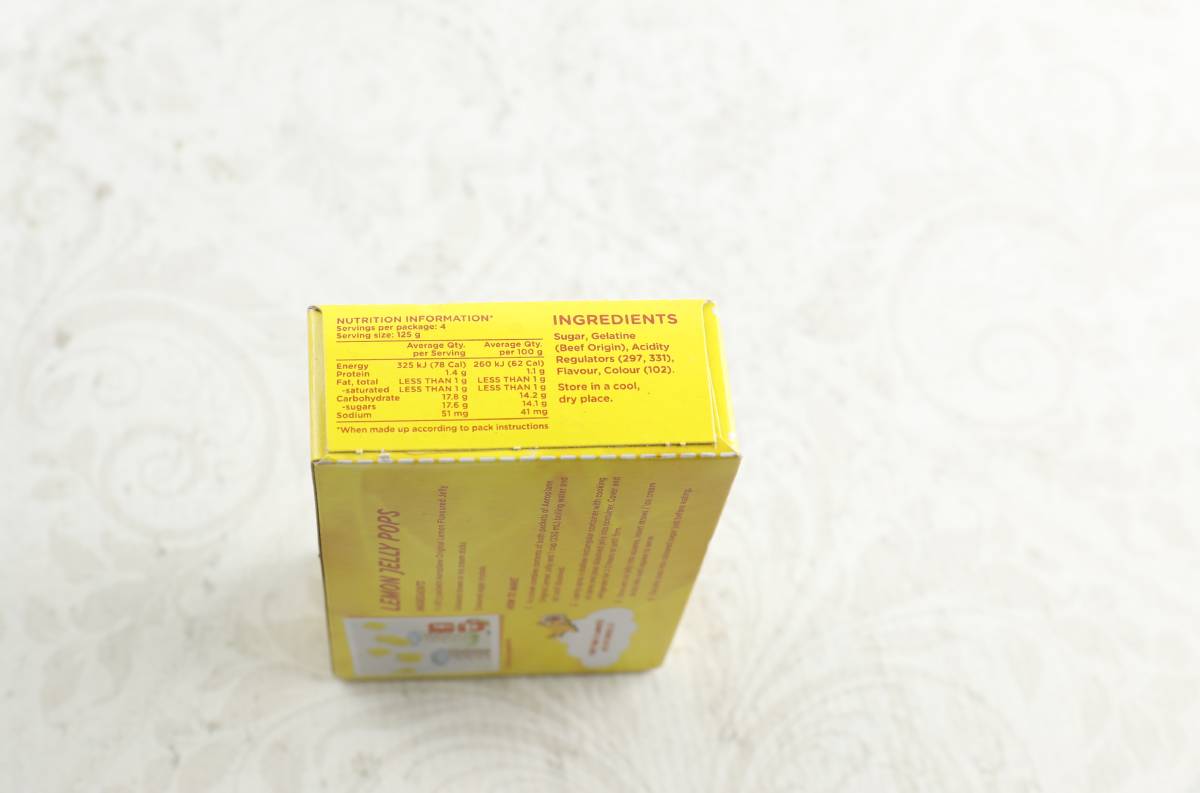
When comparing packaged foods, start with the ingredient list.
In Australia, most added food additives must be declared using their functional class followed by either their name or number.
For example:
Preservative (250) tells you the ingredient is sodium nitrite and that it is being used as a preservative.
Flavour enhancer (621) identifies MSG and why it has been included.
Emulsifier (471) identifies mono- and diglycerides of fatty acids.
In the United States, you will generally need to look for the ingredient’s name rather than its international additive number.
Interestingly, labels also have exemptions and different rules for certain ingredients. Not every substance present in food will necessarily appear with an additive number.
If this is starting to feel too difficult to navigate, don't worry. You won't need to memorise hundreds of food additive numbers to make informed choices.
I’ve put together a printable reference highlighting common additives, what they do and the situations where consumers may want to pay closer attention.
Keep it on your phone or take it shopping when you’re comparing ingredient lists.
Frequently Asked Questions About Food Additives
No. An E-number identifies an additive within the European system. It doesn’t automatically indicate a health risk.
E471 refers to mono- and diglycerides of fatty acids. These are emulsifiers that help ingredients mix and maintain texture. Their source may be plant or animal derived.
Yes. MSG, monosodium glutamate, additive 621 and E621 identify the same substance.
No. Preservatives can prevent food spoilage and improve food safety. Their health implications depend on the particular preservative, its use and the consumer.
Not necessarily. A nitrate-free claim doesn’t establish that a processed meat is free of all relevant health risks. The ingredients, curing process and overall frequency of consumption still matter.
Many are internationally harmonised, but labelling requirements, approvals and permitted uses differ between countries.
Related Content Links
- Know your Food - How food Production shapes what we eat
- Is Fruit Sugar Really Bad?
- How to Reduce Inflammation
Making Informed Choices About Food Additives
Food additive numbers aren’t something we need to fear, but they are worth understanding.
Some additives have well-established uses and reassuring safety assessments. Others deserve attention because of individual sensitivities, unresolved scientific questions or the health implications of foods in which they’re commonly used.
The aim isn’t to memorise every number or eliminate every food additive from your diet.
It is far better to understand what you’re buying and recognise the ingredient behind the number. This allows you to make informed decisions based on evidence and your personal sensitivity rather than alarming headlines.
The most useful takeaway is not which foods and additives to remove from your diet. It’s about looking at the overall quality of the food we’re eating on a daily basis. Do we have a large exposure to a lot of additives in processed or super-processed foods? Is our exposure very low, with mostly food made from scratch from our garden and the occasional evening out?
References
3. Food Standards Australia New Zealand. Food Additive Labelling.
5. Codex Alimentarius. General Standard for Food Additives Database.
7. US Food and Drug Administration. Types of Food Ingredients.
9. World Health Organization / IARC. Carcinogenicity of Red and Processed Meat.
11. Food Standards Australia New Zealand. Sulphites.
13. Food Standards Australia New Zealand. MSG in Food.
15. European Food Safety Authority. Titanium Dioxide: E171 No Longer Considered Safe.
17. US Food and Drug Administration. Food Labelling Guide.
Evidence reviewed: November 2026. This guide provides general nutrition information, not individual medical advice. Additive permissions and scientific assessments may change.


